Showing posts with label Lotus. Show all posts

2010 Lotus Sports Cars Evora Carbon Design Concept

The multi-award winning Lotus Evora provides the basis of the stunning carbon design concept unveiled at the 80th Geneva Motorshow. The car boasts a stylish carbon fibre, leather and alcantara interior, aggressive carbon diffuser and an evocative high tech composite body.
2010 Lotus Evora Carbon Concept
The head turning looks of the Evora Carbon Concept car provide a more purposeful, planted stance with the car looking lower and more aggressive. This styling direction is continued with a structural carbon fibre roof, Lotus Motorsport influenced carbon diffuser and carbon splitter. The Evora Carbon Concept car retains the same class leading handling and high tech aluminium bonded and extruded chassis of the production car.
2010 Lotus Evora Carbon Concept
Donato Coco, Director of Lotus Design announced, “The design of the Evora Carbon Concept car features exotic, high tech materials offering a good synergy with the Lotus brand image, expressing our motor sport heritage and history of stylish sports cars due to which Lotus are renowned”.
2010 Lotus Evora Carbon Concept
Carbon fibre panels with perforated leather and Matt Alcantara are featured in the interior. For example, the dashboard, footwell and inner roof are covered in Alcantara, while exposed carbon fibre can be seen on the centre console, air vents and others. It sports a carbon fibre roof, 19-inch alloy wheels with 235/35 front and 285/30 rear Pirelli P-Zero Corsa tyres.
2010 Lotus Evora Carbon Concept
While no engine tweaks have been mentioned, the drop in weight means the Toyota-sourced 3.5-litre V6 has a lot less mass to move thus performance has been significantly boosted. Be on the look-out for a production version of the Evora Carbon Concept in the not-too-distant future.
2010 Lotus Evora Carbon Concept

2010 Lotus Evora 414E Hybrid Sports Car Concept

This is the 2010 Lotus Evora 414E Hybrid, a new car that made its debut today at the Geneva Motor Show which aims to demonstrate how a hybrid car can have breathtaking performance from a highly efficient propulsion system. Lotus Evora 414E Hybrid is a full hybrid vehicle, which comes with twin electric motors.
2010 Lotus Evora 414E Hybrid
The new 414E Hybrid uses a high performance drivetrain system consisting of twin motors each delivering 204 hp (152 kW or 207 ps – this inspired the name 414E) and 400 Nm (295 lbft) of torque to each wheel via independent, single speed, reduction transmissions. With these numbers the car can accelerate from 0 to 60 mph in just 4.0 seconds.
2010 Lotus Evora 414E Hybrid
The Evora 414E Hybrid is a concept car that is equipped with a 7-speed transmission and two drive settings, including Eco and Sport. The vehicle is mainly maid in a copper color, which is used not only in the exterior but also interior of the concept, including the instrument panel, seat covers and brake calipers.
2010 Lotus Evora 414E Hybrid
The new car can be charged via a typical household plug or the car’s onboard generator. An additional range is provided by the Lotus Range Extender engine, an optimised 1.2 litre, three-cylinder engine capable to deliver (48 ps/47 hp). The Lotus Evora 414E Hybrid has a total range of 480 km (300 miles) and can be driven as a fully-electric car for about 56 km or 35 miles.
2010 Lotus Evora 414E Hybrid
Also, the car features HALOsonic Internal and External Electronic Sound Synthesis technologies from Lotus and Harman International, which means that it will provide sound contouring within the cabin and improve pedestrian safety outside the vehicle. The car comes with a sports mode that can simulate a 7 speed, paddle shift transmission combining exceptional driver involvement for a hybrid sports car.
2010 Lotus Evora 414E Hybrid
Dr Robert Hentschel, Director of Lotus Engineering said: “Innovation has always been at the heart of Lotus and is needed now more than ever. The Evora 414E Hybrid is the perfect demonstration of Lotus Engineering’s core competencies: lightweight architectures, efficient performance, electrical and electronics integration and driving dynamics. 
2010 Lotus Evora 414E Hybrid
The technology demonstrator represents an encapsulation of the advanced technologies that Lotus Engineering continues to develop to overcome the current environmental challenges facing the automotive industry and showcases the future direction that the sector is taking and why Lotus Engineering is perfectly placed to lead the technological development in this area.” 
2010 Lotus Evora 414E Hybrid

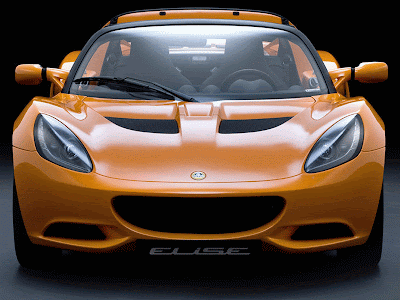
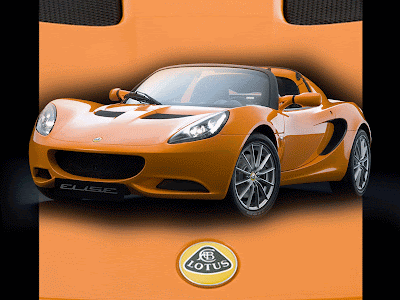
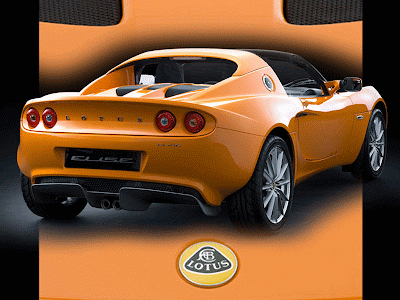
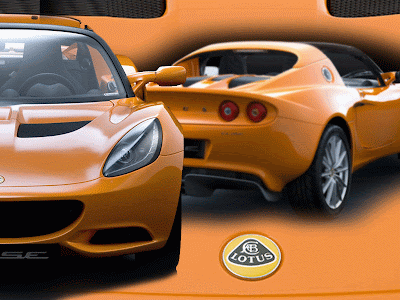
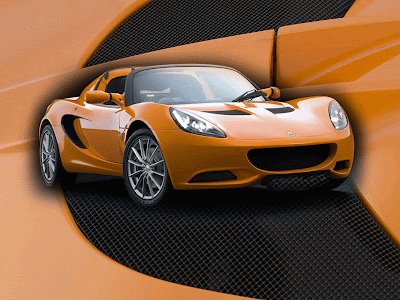
2011 Lotus Sport Cars Elise With Valvematic System Plus Combined dual VVT-i

Making its debut at the 80th International Geneva Motorshow, the 2011 model year Lotus Elise introduces a number of changes and improvements to maintain its class leading position. The Lotus Elise revolutionised the sportscar market 14 years ago when the small lightweight agile 2-seat mid engine sportscar was introduced. By ensuring that the Lotus Elise stuck rigidly to Lotus' core values of performance through light weight, the Lotus Elise was able to produce supercar performance with city car economy.
2011 Lotus Sport Cars Elise
The body of the new 2011 Lotus Elise is an evolution of the iconic Elise design, retaining the character and style, while offering a more planted, purposeful stance and a pure, contemporary look that links it to the Evora. As with all Lotus product the design is an exciting blend of dramatic style and functional efficiency. At the rear of the car the new engine has been encased by a distinctive "twin-spine" engine cover whilst lower down a more aggressive diffuser is tightly wrapped by an elegant new bumper design that now includes the rear licence plate.
2011 Lotus Sport Cars Elise
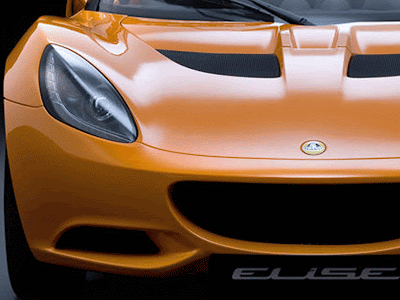
New headlamp units with distinctively sculptured LED lighting guides (incorporating daytime running lamps and direction indicators) give a contemporary twist to this classic design. Elsewhere, the signature, Lotus "mouth" and familiar sculptured forms have been sensitively refined to give a crisper, more dynamic look.
2011 Lotus Sport Cars Elise
The rear boot is now opened from the cockpit rather than via a separate key operation. The high quality feel of the Lotus Elise is continued throughout the car with the Lotus Elise graphic incorporated into the new side LED direction indicators, like those on the Evora. The driving position, from the perfectly positioned pedals and steering wheel, to the comfortable and supportive seats with ProBax technology means that, like all Lotus cars, the driver becomes part of the car rather than being just a passenger. With the sleek new body the aerodynamics have improved giving a reduction in the coefficient of drag of 4%.
2011 Lotus Sport Cars Elise
The Lotus Elise introduces the new 1598 cm3, 1ZR-FAE engine, provided by Toyota. The key to this engine's performance and efficiency is the Valvematic system (a variable valve lift mechanism), which is combined with the dual VVT-i (Variable Valve Timing-intelligent). The engine continuously controls intake valve opening/closing timing and the intake valve lift to vary the volume of the intake airflow, giving significant improvements in efficiency and fuel economy. This ensures optimal performance based on the engines operational condition, thus helping the Lotus Elise achieve both high fuel efficiency and high performance.
2011 Lotus Sport Cars Elise
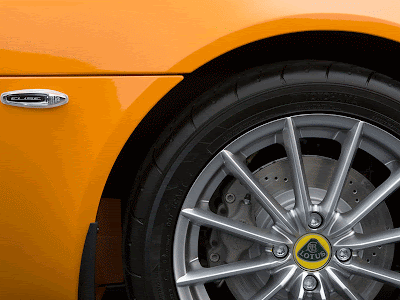
First of all, the maximum power output is achieved at near maximum revs (engine speed) of 6800 rpm and maximum torque (a respectable 160 Nm, 118 lb.ft) is reached at 4400 rpm. This gives a good combination of mid range pull but also encourages the driver to rev the engine to the maximum permitted engine speed of 7000 rpm (transient rev limit). Like all Lotus Elise sportscars, there are three shift up lights, on the binnacle cumulatively lighting when the driver is getting closer to the rev limiter and when all three are illuminated, they flash to indicate that the driver is almost on the rev limiter so time to change up a gear! New cast wheels have been designed specifically for the Lotus Elise and the new optional forged wheels weigh just 29.26 kg per set, 2.14 kg lighter than a set of lightweight cast versions. Both are available in silver or black colour.
Andreas Prillmann, Chief Commercial Officer for Lotus Cars said, "In its 14 years of production the Lotus Elise has accounted for 32% of all the 61 years of Lotus production, illustrating how significant to the brand and well loved it is. The 2011 Lotus Elise is greener, purer and more desirable, making it even more relevant to today's marketplace. The new Elise underlines Lotus' reputation as one of the most innovative sports car manufacturers in the world."
2011 Lotus Sport Cars Elise
The height of the engine cover has been raised by 34mm to accommodate the taller 1ZR engine compared to the previous 1ZZ engine from the outgoing model due, in part, to the additional Valvematic technology included on the new engine. This has given Lotus engineers an opportunity to subtly redesign the rear engine cover to match the design theme from the front and rear of the car.
The legendary Lotus ride and handling gives a superb high performance, sporty drive, combined with a compliant ride and progressive on limit handling, it makes the Lotus Elise a car that demands to be driven.
The entry level Lotus Elise weighs 876 kg, making it one of the lightest fully homologated sportscars in the world. This low weight translates into efficient performance with minimal environmental impact in terms of emissions and fuel consumption. The efficiency of the Lotus Elise structure means that the 136 PS (100 kW, 134 hp) delivers phenomenal performance.

2011 Lotus Esprit Sports Car will be a wholly different Beast powered by a 4.4 liter V8 engine

2011 Lotus Esprit Sports Car

The guys over at AutoCar have caught the upcoming Lotus Esprit testing in cold-snowy weather of Sweden. After running some DVLA records and matching the license plate, AutoCar has learned that the prototype is powered by a 4.4 liter V8 engine. Lotus sources have previously said that BMW may be the supplier for Lotus’ 2011 Esprit.It’s possible that the new Lotus Esprit will carry the 4.4 liter twin-turbo V8 engine from the new BMW X6, but will most likely be tuned to develop 500 horsepower.Currently the 4.4 liter twin-turbo from V8 produces 400 horsepower. The engine is also expected to be used in other BMW models including the X5 and the 7-Series. Lotus engineers will most probably re-work the engine management to reach numbers closer the Nissan GT-R and the Porsche 911 Turbo.
According to Lotus insiders, the next-gen Elise will arrive sometime in early 2011 followed by an all-new V8-powered Esprit in 2012...............................2011 Lotus Esprit Sports Car

The 2011 Elise will likely be built upon an evolved version of the current model’s extruded-aluminium underpinnings and continue the same formula that’s made the pint-sized sportscar a track day fave, but the Esprit will be a wholly different beast.
While the new Elise is all but locked in, the Esprit project is very much dependent on whether Lotus can sell enough Evoras to fund it. The timeline for the Esprit is also at the mercy of the global economic situation, with Lotus likely to delay the Esprit and forge ahead with a far less costly drop-top Evora if the recession persists much longer.
If it launches on time, the Esprit could be Lotus’ best hope of gaining a much larger share of the sports car market.
There are speculations stating that the 500bhp V10 powerplant can be the source of power for the Lotus Esprit, which will be released in 2012...............................2011 Lotus Esprit Sports Car

The engine is currently being used in the Lexus LF-A, a car that has not yet been launched itself. Being connected with the Japanese carmaker Toyota, Lotus has access to its entire range of parts and components, as well as powerplants from the Lexus line. This points to the likelihood of an Esprit flagship, costing more than ?100,000, equipped with the compact 8500rpm V10 unit (to rival the Lamborghini Gallardo), including a less expensive variant equipped with the 5-liter, 417bhp V8 from the Lexus IS-F and an entry-level model coming with a Lotus-tuned direct-injection Toyota V6 unit that can come up with 300bhp.
Although a V8 or a V10 unit would definitely boost the profile of Lotus, there is also a possibility of an Eco Esprit. Lotus is moving forwards with more efficient products with lightweight engineering and its keen interest in alternative fuels and hybrid solutions. This is also underline by its partnership with the electric car manufacturer Tesla...............................2011 Lotus Esprit Sports Car

The Esprit was inspired by the larger bonded and extruded aluminum chassis of the recently launched Evora, the rear section of which have been developed to accommodate both transversely and longitudinally fitted engines. Although the Lotus has shown that it can develop a new model in a short time (the Evora, for example, was developed in 27 months), the work on the Esprit will only reach its maximum when the Evora is being swept out of showrooms in the UK, Europe and US. It is the Malaysians who are funding the Evora project, with the persuasion of Lotus CEO Mike Kimberley.

Lotus Exige Scura Sports Car uses the 1.8 litre Supercharged and Intercooled 260 PS engine


Lotus Exige Scura

Lotus Cars
unveils its latest special edition - the Exige Scura, so called due to its dramatic matt black and carbon fibre theme, at the Tokyo International Motorshow on 21st of October 2009.Translated as ‘dark' from Italian, the name ‘Scura' reflects the stealth character of this already fierce looking Lotus and its stunning soft-feel matt black paint finish. Limited to just 35 cars globally, this Exige evokes a desire to ‘indulge your dark side'. This is a serious looking car and enhancements to performance and a reduction in weight from the production level Exige S means that the Exige Scura demands to be driven by a serious driver.
Luke Bennett, Director of Lotus Cars said, “The Exige Scura is a stunning vehicle which offers an adrenaline fuelled experience and is a real head-turner! Our Exige customers choose Lotus because we deliver thrilling performance and dynamic design and this special edition fits the bill on both counts.”
Continuing the dark ‘Scura' appearance into the interior, carbon fibre is used extensively to compliment the exterior theme and reduce weight. The seats and centre console are crafted from carbon fibre and the handbrake and gear knob have a special anodized treatment which leaves the metal with an anthracite colour finish. All carbon fibre components have been beautifully finished in high-gloss clear lacquer allowing the weave to remain exposed which gives the cabin a raw and racy ambiance.
Lotus Exige Scura

Whilst there is no doubt that this is a visually stunning car, the Exige Scura is not just about its looks – it begs to be taken on track, and its racing character encompasses poise, power and technology to make it a serious contender. Equipped with the most powerful engine in the Exige range and generating 260PS, the Exige Scura achieves a top speed of around 245 km/h and reaches 0-100 kmh in just 4.1 seconds.
Other equipment fitted as standard to boost the Exige Scura's track credentials include:
Launch control to ensure optimum performance from a standing start
Variable slip traction control, enabling the driver to tune the car to track surface conditions and their own driving style
Ohlins 2-way adjustable dampers for personalised ride and handling characteristics
Roger Becker, Vehicle Engineering Director, highlighted the performance of the Exige Scura, “There are very few cars in the world that turn in the performance of the Exige Scura without the penalty of very high fuel consumption and emissions. As with all Lotus sportscars we offer the best of both worlds – a zero to 100 km/h time of just over 4 seconds and a CO2 figure of 199 g/km; all this is down to light weight and a strict adherence to Lotus' core brand values.”
Considering the performance on offer, the Exige Scura boasts impressive all round fuel economy with an Official European Combined Cycle figure of 8.5 litres/100 km and 6.5 litres/100 km on the Official European Extra Urban Cycle and emissions of 199 g/km of CO2.
Orders for the ‘Lotus Exige Scura' will be accepted from 21 October 2009 in Europe, South Korea, Australia, South Africa, Thailand, Taiwan, Hong Kong, Singapore, New Zealand, Indonesia and Malaysia. This special edition will be available on the same basis in Japan known as the ‘Lotus Exige Stealth'.